
Exhibitions
Exhibitions
Within the framework of the MATCH project, a series of five local expositions will take place between April and November 2026, following the post-production phase of the artistic residencies. These expositions will present the works developed by the participating creatives in the countries where the residencies were hosted, offering a public moment of sharing, reflection, and exchange with local audiences.
As part of the project methodology, MATCH will experiment with different formats for these expositions, co-developing presentation strategies with the artists during their residencies. The expositions will be hosted in Athens, Nicosia, Marseille, Barcelona, and Izmir, activating diverse cultural spaces and contexts across the Mediterranean.

Exhibition #1

ATHENS
24-26 APRIL 2026
Three artists, Garance Maurer, Annalisa Zegna, and Vitoria Kotsalou, undertook residencies at the Duncan Dance Centre starting from October 2025 to April 2026, each exploring climate change through their individual artistic lenses while exchanging ideas across their practices. Garance focused on fire, visiting the burned forests of Parnitha and the island of Mytilene, and ultimately planting an oak tree in the Centre’s garden as a symbolic gesture of regeneration. Annalisa focused on water, researching Athens’ underground rivers and water systems, travelling to Aegina to collect wild clay, and offering a ceramic pot as a gesture of resilience against drought. Vitoria’s residency followed a slower, more sustained rhythm centred on the garden itself – spending extended time in it, co-organising monthly open Wednesdays and Sundays for all ages, and hosting weekly dance sessions under the series “Do you need a garden?” to invite the broader dance community into shared practice. Together, the residents transformed the garden into a living laboratory, a space for ecological experimentation, artistic development, and community gathering. Underlying all three practices were shared questions: What do you protect? What do you depend on? Why do something? What can you do? – questions that wove through the work as both artistic inquiry and climate reflection.
The curatorial aspect of MATCH Athens opens three distinct pathways to ways in which we can feel, understand, and move within the Mediterranean landscape and as a Mediterranean landscape, a plant, or a body of water. It proposes movement, both metaphorically and literally, as a means of connection, redefinition, and envisioning, and introduces a cyclical rhythm of observation, listening, dialogue, and action. The Match exhibition creates a shared space and examines the time we spend together as an active inquiry, while proposing experiential practices, networking, and exchange as an antidote to the advance of climate change. In the resident’s work, water, fire, and the garden are fluid bodies, capable of conveying, retaining, and forming, of transforming and being transformed, reminding us that we are all porous organisms and interconnected worlds, standing, listening, and moving amidst conditions of constant change.
Opening hours:
April 25 (Saturday): 6:00 pm – 10:00 pm
April 26 (Sunday): 11:00 am – 4:00 pm

Annalisa Zegna
Annalisa Zegna is an artist and researcher exploring the relationships between human and non-human landscapes amid contemporary ecological and social crises. Her practice weaves together visual, performative and collaborative processes, with particular attention to the public sphere and site-specific interventions. She lives and works in the Italian Alps, is co-founder of Spazio HYDRO in Biella, and works as Research and Production Coordinator for the UNIDEE Residency Programs at Fondazione Pistoletto.

Garance Maurer
Garance Maurer is a researcher, artist and textile designer whose practice traverses landscapes and disciplines, combining fieldwork with the creation of materials, colors and stories. Anchored in site-specific approaches, ecosocial justice and ecofeminist perspectives, since 2022 she has been researching fire ecologies and practices of good fire across Mediterranean climate regions. She is an associated artist of the Fire School (L’école du feu) in Marseille, where she is based, co-founder of the Collectif Trouble, and an active member of Floating University Berlin.

Vitoria Kotsalou
Vitoria Kotsalou studied psychology and is a self-taught dancer and choreographer. As a choreographer and artist, she uses dance as a way of being, a means of thinking and assimilating the world, and as a field of connection with the intelligence that governs the nature of things. She is one of the founding members of the non-profit organisation R.I.C.E. and the RSOD Dance School on the island of Hydra. She is a close collaborator of choreographer Michael Klien and an active member of the En Dynam group since 2014.
Opening weekend recap:
1. Friday presentation / NTUA (April 24)
A presentation took place at the National Technical University of Athens (NTUA), where Annalisa Zegna and Garance Maurer introduced their research to students, followed by Nicholas Anastasopoulos presenting the MATCH project. The session opened a dialogue on ecological practices, field-based research, and interdisciplinary approaches linking art, architecture, and environmental thinking.
2. Water / Pikrodafni stream walk (April 24)
A walking exploration along the Pikrodafni stream with the participation of Annalisa Zegna, Anna Tzakou and Sylvain Maestraggi. The session focused on urban hydrologies and the hidden infrastructures of water in Athens, approaching the stream as a living system that connects ecosystems, landscapes, and human practices.
3. Fire / Parnitha field visit (April 25, morning)
A site-based exploration of the burned landscapes of Mount Parnitha presented by Garance Maurer as part of the Pyroscapes research. The visit engaged with fire-affected terrains through walking, listening, and discussion, reflecting on fire as an ecological force and on practices of coexisting with altered landscapes.
4. Kiln / ceramic firing process (April 25–26)
Starting on Saturday, Maria Chorafa participated in constructing and using a temporary kiln to fire ceramic works on site. On Sunday morning, the fired pieces were collectively excavated from the ashes, in a shared process of uncovering and revealing objects transformed through fire.
5. The Ecology of the Garden / Duncan Dance Centre (April 25, evening)
A collective discussion presented by Marios Desyllas, focusing on the garden as a dynamic ecosystem shaped by visible and invisible relationships. The session opened a shared space for reflection and exchange on ecological processes, practices of care, and ways of inhabiting living systems.
6. Saturday evening presentations / Duncan Dance Centre (April 25, 19:00–22:00)
An exhibition presentation took place at Duncan Dance Centre featuring Annalisa Zegna, Garance Maurer. Also Vitoria Kotsalou presented research on embodied orientation and ecological perception, proposing a “technology of orientation” through movement, attention, and multi-sensory practices. Her presentation included participation from the Choir of Vyronas.
7. Sunday workshops (April 26)
A series of workshops for children and adults focused on the creation of plant-based inks from flowers and herbs, as well as clay-based practices. Participants engaged in hands-on exploration of natural materials through drawing, painting, and tactile making processes connected to ecological awareness and everyday creativity.
8. Sunday weaving / archival loom process (ongoing each Sunday)
An ongoing archival process unfolds every Sunday through two looms on which participants collectively weave. This practice forms a living archive of materials, gestures, and shared experiences developed throughout the program, gradually accumulating as a textile record of the project.
Photo credits: Delta Pi


Exhibition #3
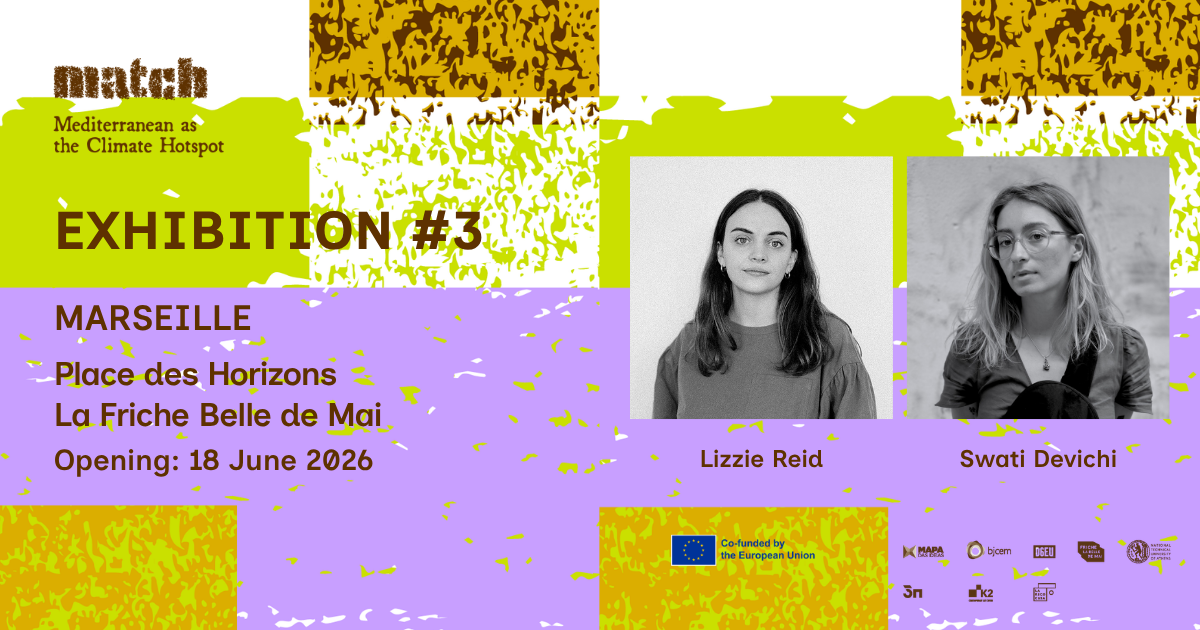
MARSEILLE
OPENING: 18 JUNE 2026
The MATCH journey continues in Marseille with the third exhibition, hosted by la Friche la Belle de Mai on 18 June 2026.
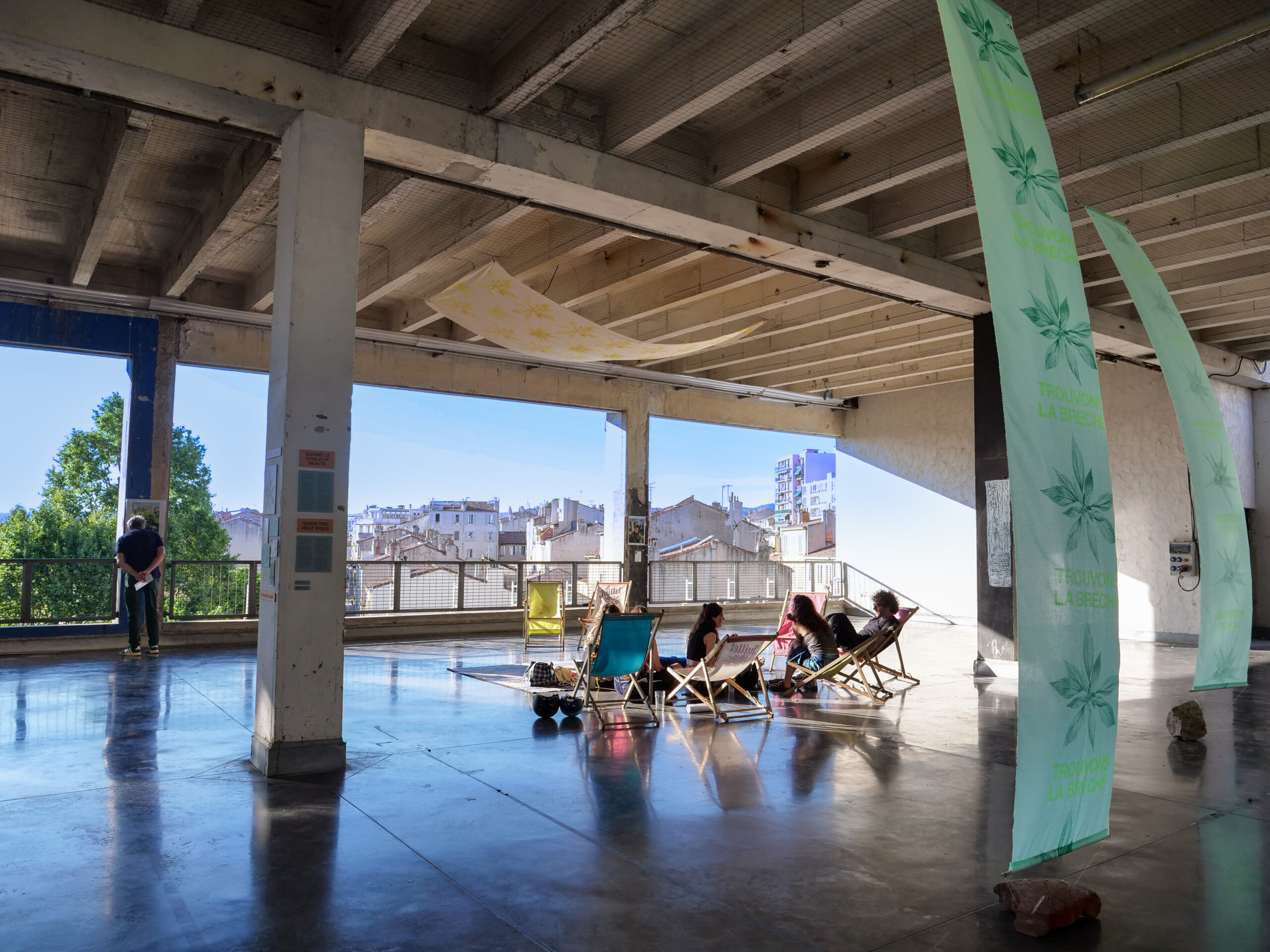
Following their residency earlier this year, artists Swati Devichi and Lizzie Reid return to Marseille to share the outcomes of their research through a series of interventions on the Place des Horizons, a space opening to the public for the first time this summer as a climate shelter. This exhibition is part of the Open Studios at la Friche la Belle de Mai, which focus particularly on the Mediterranean and bring together the work of artists participating in La Friche’s Mediterranean residency program and of the artists supported by Triangle Astérides, Contemporary Art of National Importance based in la Friche.
Lizzie Reid explores extreme heat and how it reshapes relationships between people, buildings, and the natural environment, focusing on collective ways of coping and adapting to rising temperatures in the city.
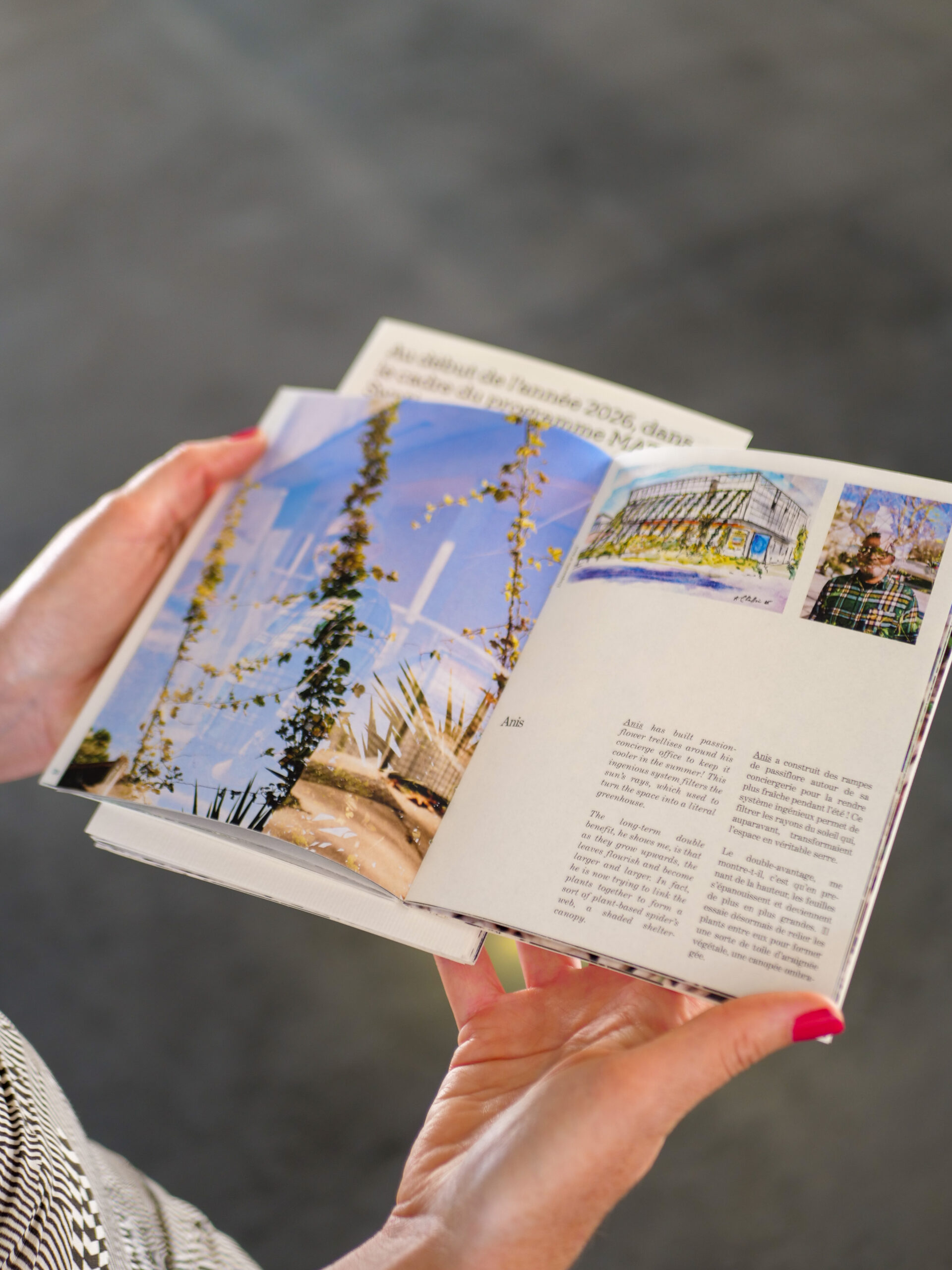
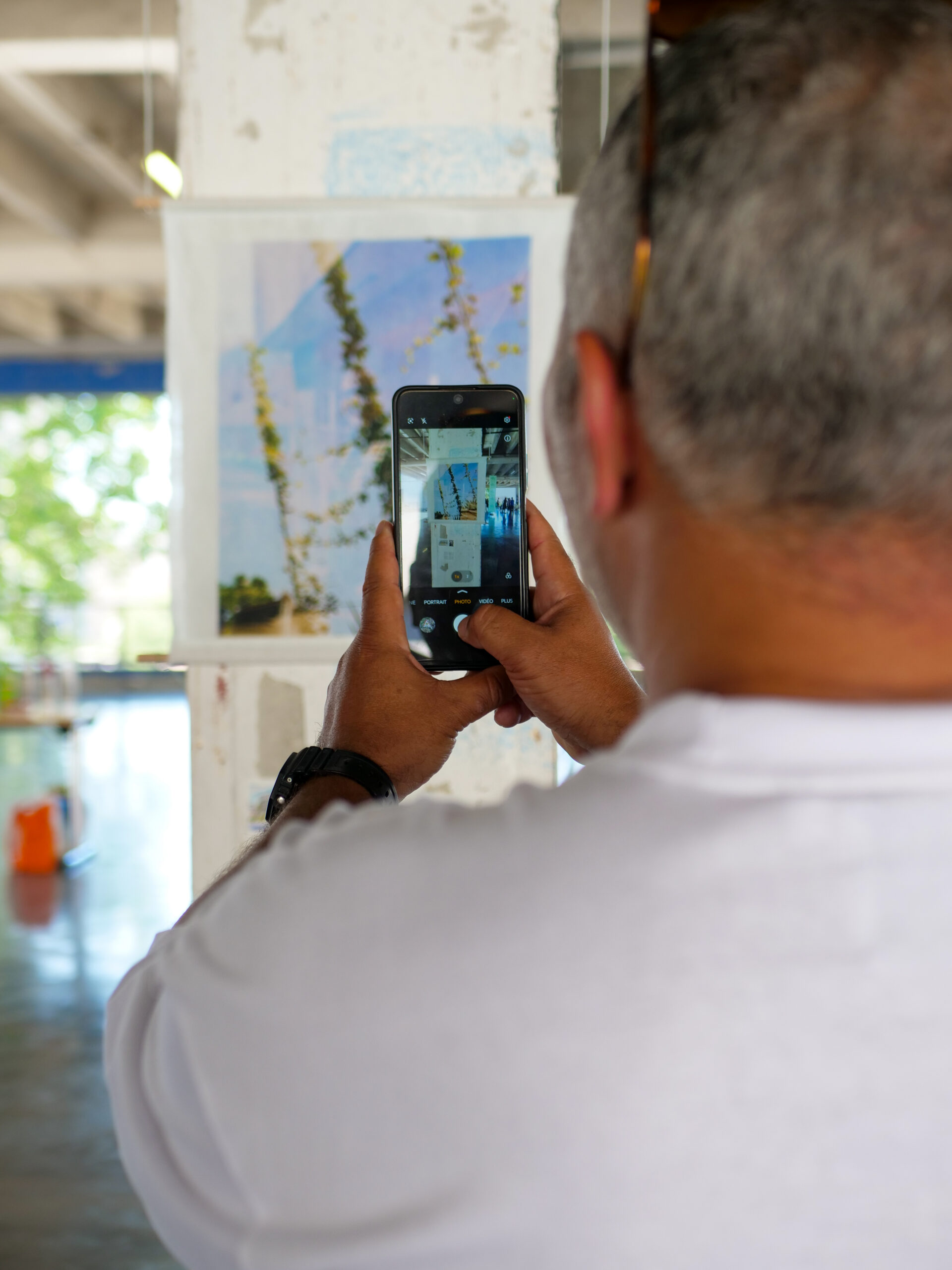
Swati Devichi investigates the hidden histories of women in the Belle de Mai neighborhood, connecting archival research with double-exposure portraits that link past lives to the area’s present vegetation and communities.
Opening:
18 June 2026, from 16:00
Friche la Belle de Mai, Marseille: 2nd floor (R+2) of the Manufactures & Place des Horizons

Lizzie Reid
Lizzie Reid explores how creativity can connect people with social and climate justice. With her work she seeks to rally people around causes, tell stories with care, and make complex ideas easier to understand – through campaigns, films, digital projects, installations, and more. From a digital archive of visual solidarity, to a pop-up installation encouraging neighbourly interaction, to a photo essay about a community garden, Lizzie works collaboratively to engage communities. Her approach blends creativity, activism, and academia – with extensive experience in the creative industry, years of grassroots activism and a recent MA focused on Political Ecology, Degrowth, and Environmental Justice at the Universidad Autónoma de Barcelona. Lizzie has lived and worked in London, Amsterdam, and Barcelona, where she is now based.

Swati Devichi
Swati Devichi is trained in social sciences at École normale supérieure in Paris. Her recent artistic projects combine ethnographic writing and analog clichés. Swati began photographing more intentionally, then professionally, at the end of 2023, and explores themes such as everyday politics, urban commons, and emotional attachment to territories. Swati works on commission in Portugal and France, and her photographs have been exhibited in Rome, Budapest, Paris, Lisbon, and New York.
Opening recap:
On Thursday, June 18, the exhibition resulting from the residency of artists Swati Devichi and Lizzie Reid within the MATCH (Mediterranean as a Climate Hotspot) programme opened at the Place des Horizons at La Friche.
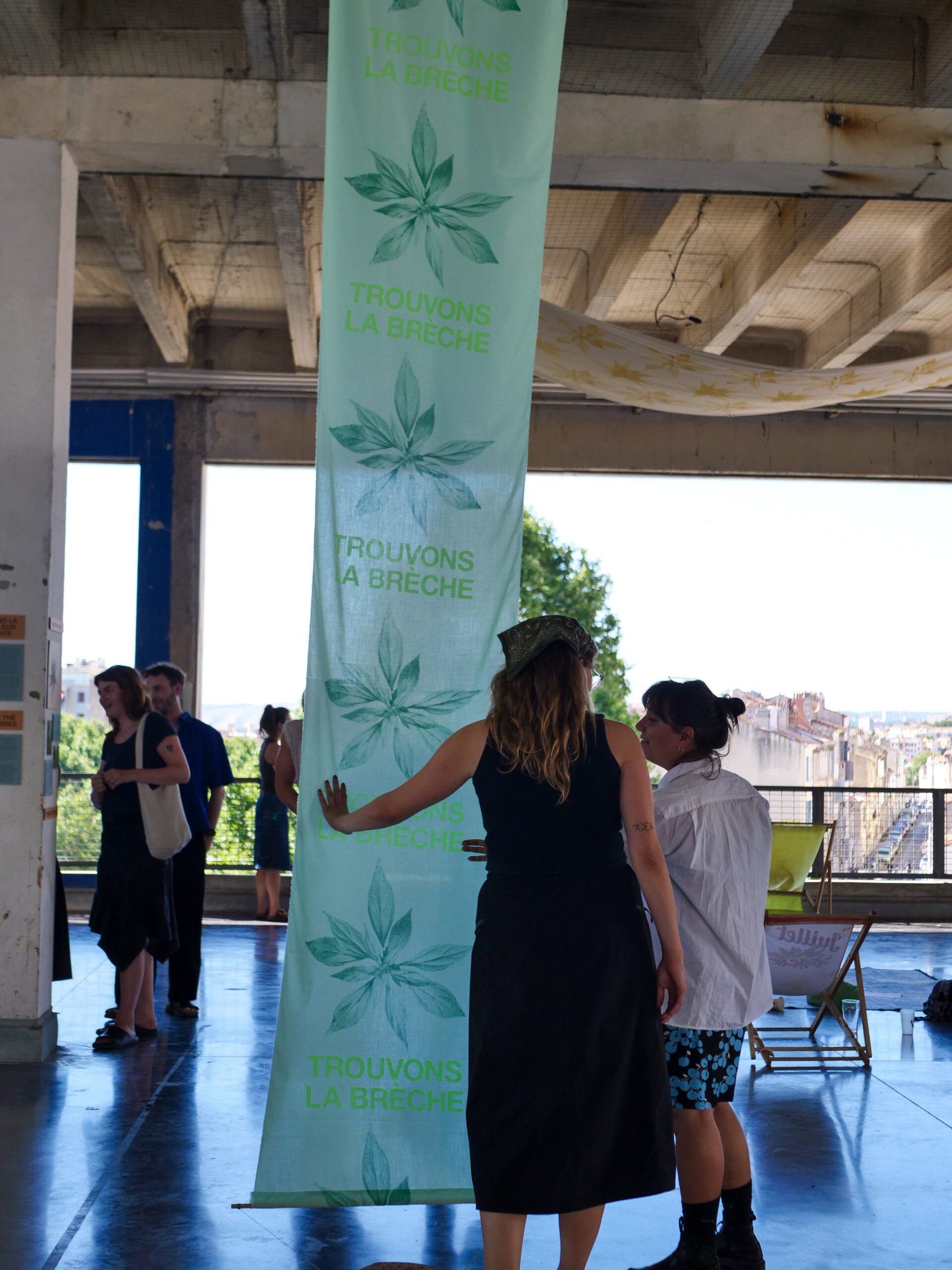
This naturally cool area of La Friche has been opened to the public for the first time this summer as a climate shelter, an îlot de fraîcheur (island of coolness).
Their work will be on view starting July 6th and throughout the summer season for all visitors, residents, and staff passing through the space.
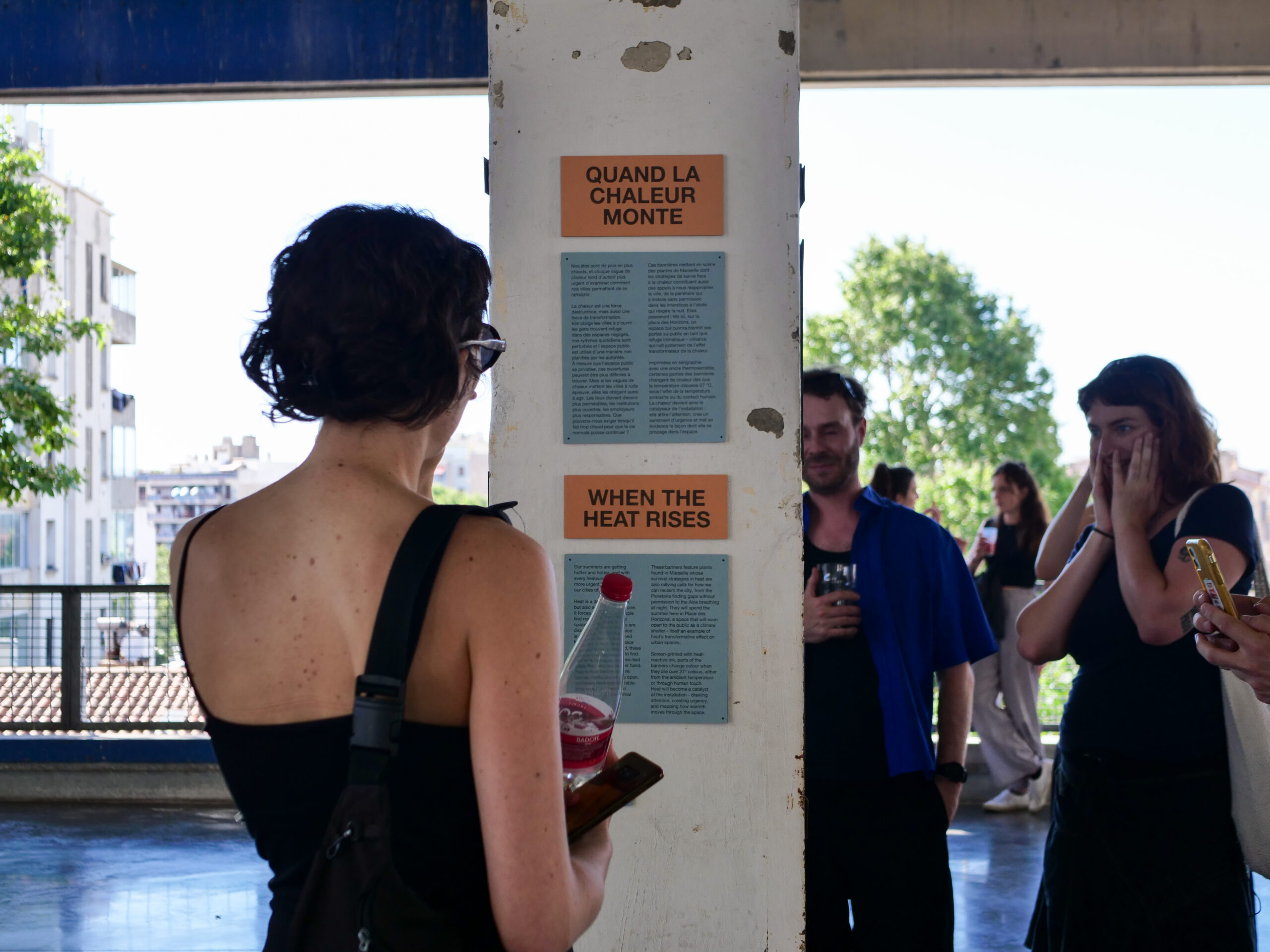
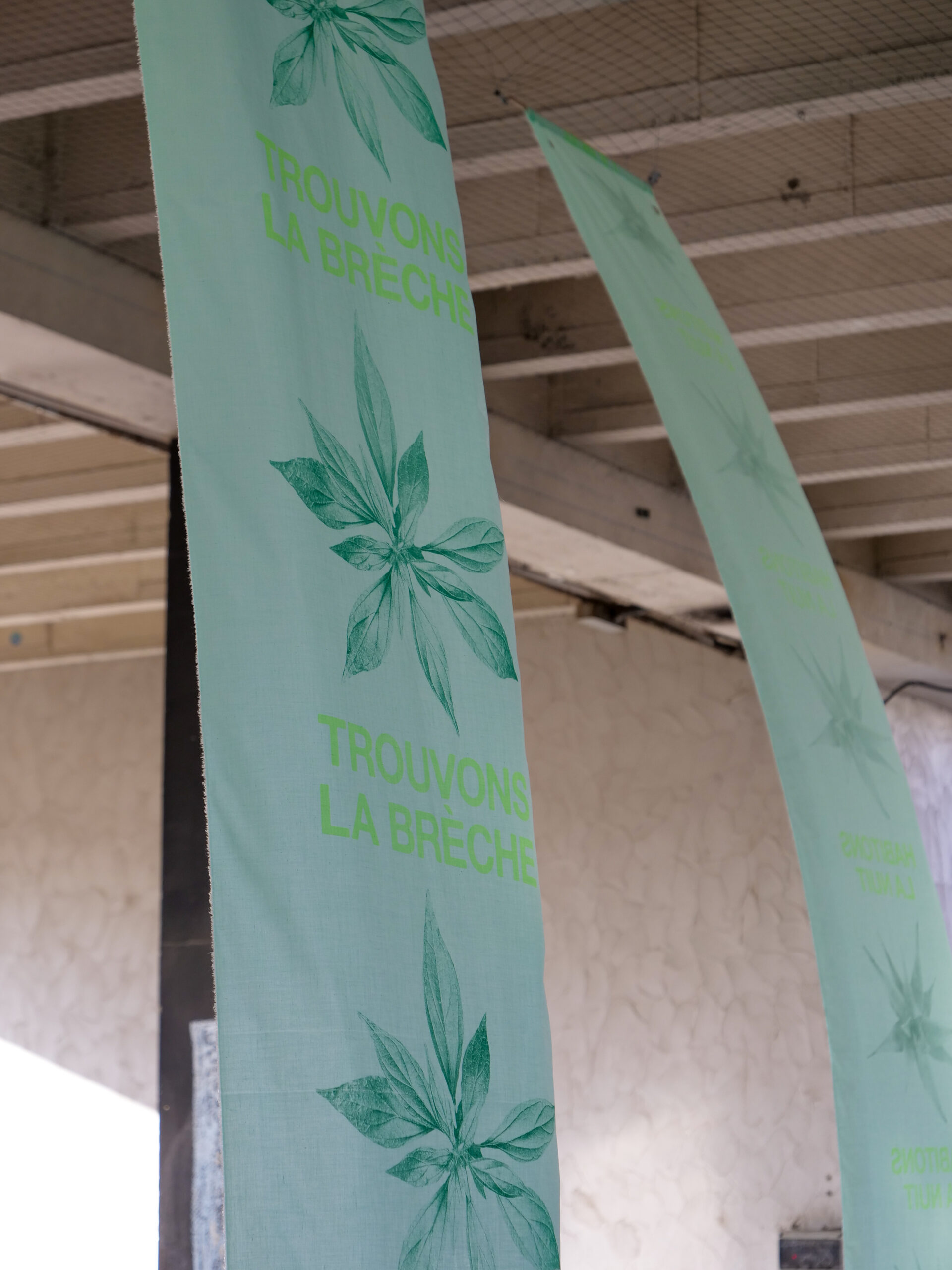
Lizzie Reid’s work explores how extreme heat reshapes urban spaces. Through her encounters with workers, gardeners, visitors, and neighbors, she came to view heat not merely as a destructive force, but as a transformative one. Rising temperatures force cities to open up: people find refuge in overlooked spaces and create new rhythms in their daily lives. Inspired by plants found in Marseille—whose survival strategies in the face of heat also serve as calls to reclaim the city—she has created large screen-printed textile banners using thermochromic ink, which will inhabit the Place des Horizons throughout the summer.
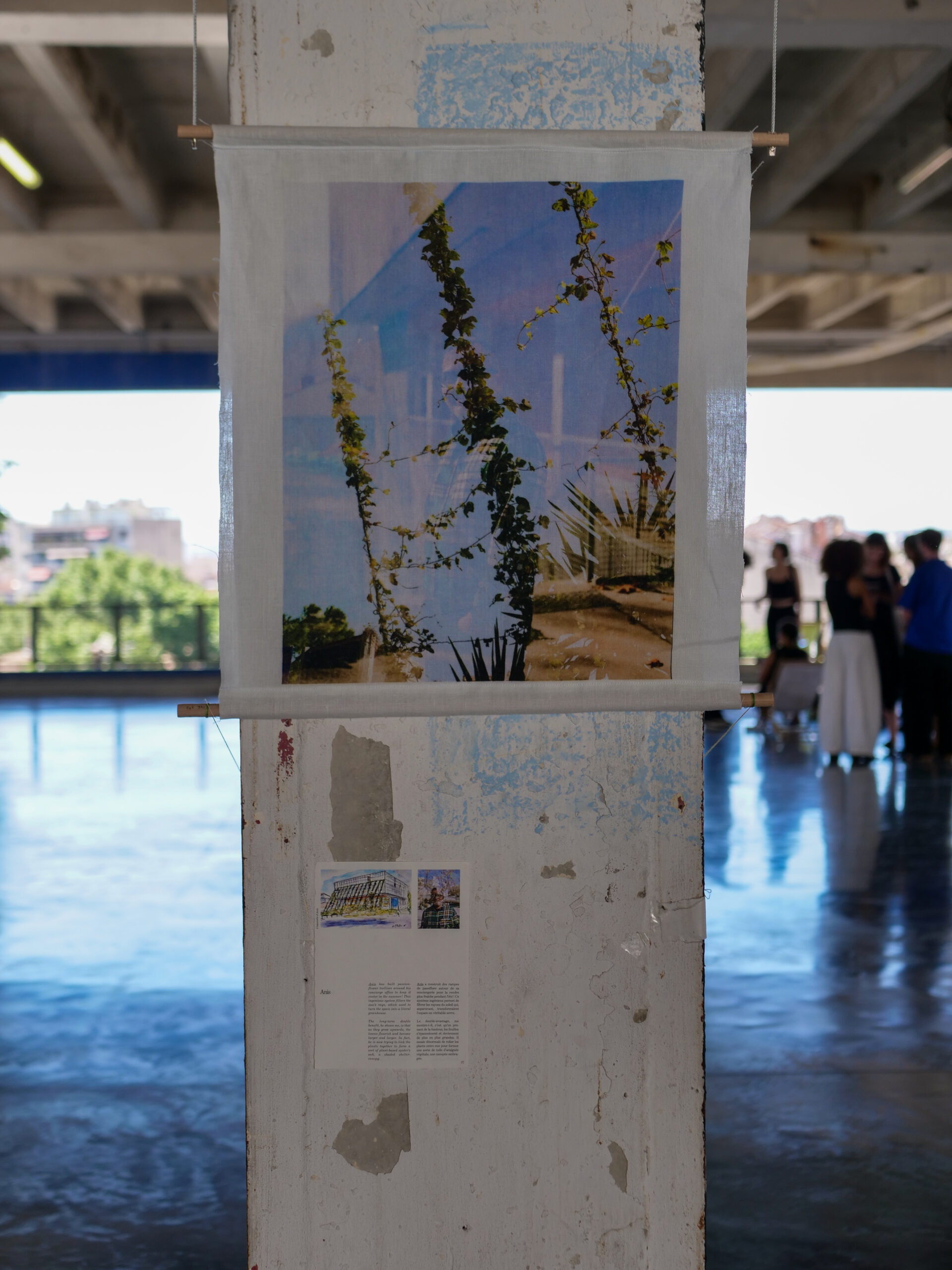
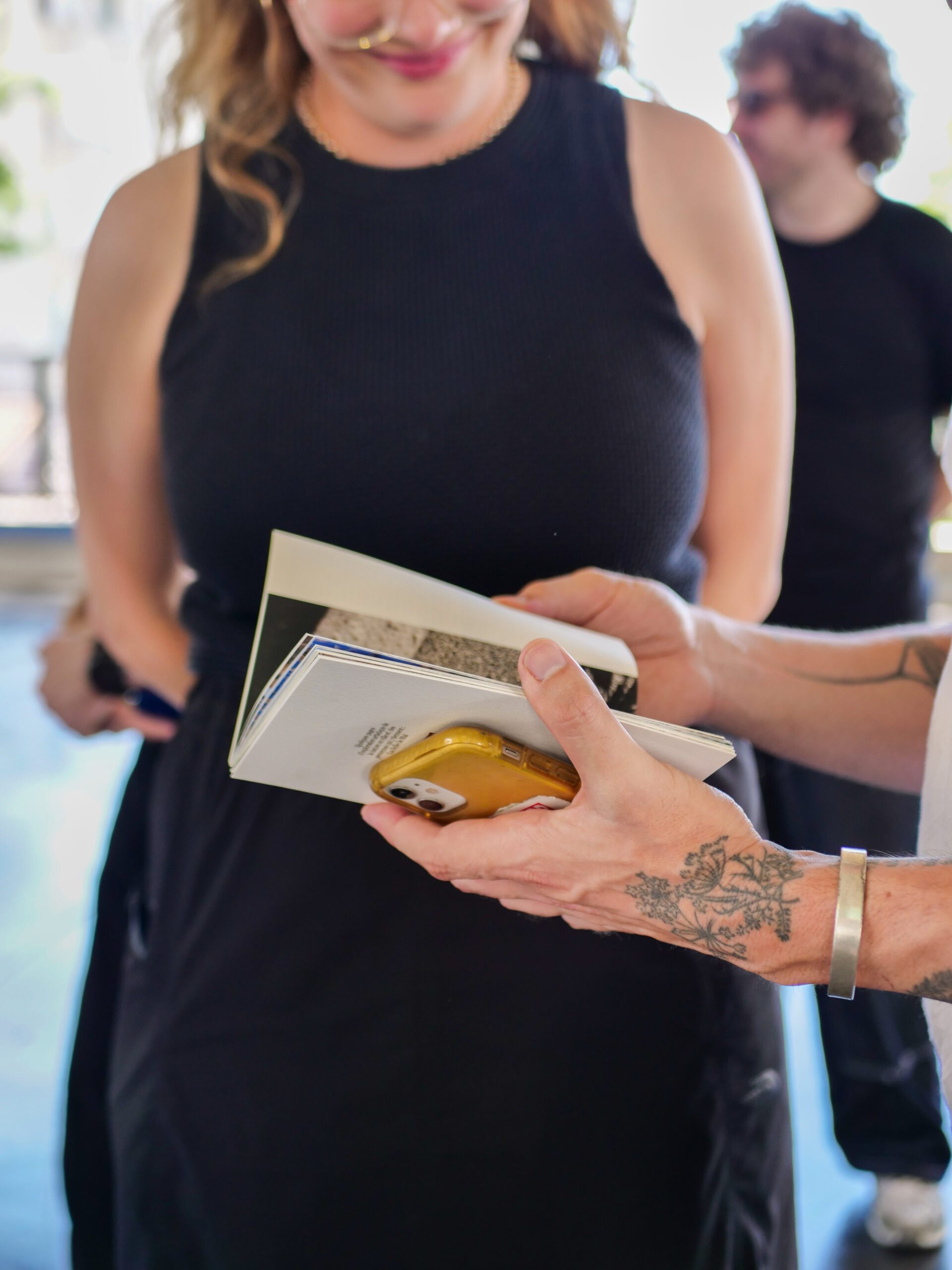
During her time in Marseille, Swati Devichi focused on cherished, loved vegetation—the kind we hold dear. She collected stories that recount a strong connection to spontaneous urban greenery. In these narratives, plants are not mere backdrops but full-fledged presences: they inhabit memories, ambitions, and emotional daily lives. To give them a visual presence, she used analogue double exposure to create a series of portraits with the participants. Together, these portraits form a sensitive mapping of the neighborhood, where emotional relationships with the living world become a way of thinking about the commons and urban resilience. For this end-of-residency presentation, she will showcase medium-format portraits alongside a research-creation book printed in a limited edition.





Exhibition #2

NICOSIA
OPENING WEEKND: 25-26 APRIL 2026
EXHIBITION: 27 APRIL-28 MAY
As part of the MATCH residency in Nicosia, artists Christina Zampoulaki and Caterina Miralles presented their collaborative research during an open studio at the Gardens of the Future in December 2025. Their project, Earth-bound Exercises, developed through their residency and collaboration, forms a living inquiry into how we perceive, document, and relate to land shaped by extraction, colonial histories, and ecological transformation.
Developed across the Gardens of the Future, the project reflects a shared commitment to rethinking our relationship with the environment. Their process weaves together field research, mapping technologies, water systems, food ecologies, and material experimentation, proposing land not as a resource to be consumed but as a living, dynamic system, one that carries memory, absorbs history, and invites new forms of understanding.
As a lasting contribution to the Gardens, the artists have created a permanent installation in the form of a water-collection and filtration structures, reusing existing garden components. In this embodiment of their non-extractive approach, they offer a functional and symbolic gesture of care that will continue to support the garden’s ecosystem over time.
Similarly, the project opens up into the back garden for installations, and while re-inforcing the resilience of living systems, it also actively expands the space of the Gardens, inviting visitors into a newly accessible landscape shaped by collaboration, research, and a shared commitment to sustainable futures.
Opening hours:

Christina Zampoulaki
Christina Zampoulaki is a transdisciplinary artist whose practice explores relationships between living organisms, material systems, and shared experience. Her practice is based on “each other,” the idea that the materials that make up the world are alive and that human and non-human bodies exist in continuous relation. Through food, natural materials, and biomaterial research, her work traces interdependence across ecological and global systems.re alive, and that our bodies function in constant collaboration with theirs.
“Water in Cyprus is scarce, uneven, and negotiated. It arrives in rainfall, in reused greywater, and manual care; each source carrying its own limits. The garden is a hybrid water system, where plants and human interventions operate together as networks of collection, storage, and redistribution. Small filtration points catch and redirect water; plants absorb, retain, spread, or shade it. Each species acts as a living technology, a node in an interconnected infrastructure. Water moves unevenly, forming clusters, gaps, and flows that shape the landscape. Paths and formal layouts fade in importance. The garden is read through moisture, shade, and access to water; a dynamic map of relations, dependencies, and emergent patterns.”

Caterina Miralles
Caterina Miralles is a Barcelona-based artist, architect, and educator whose audiovisual practice examines how the built environment shapes social and emotional experience. During the one-month residency at Gardens of the Future in Nicosia, as part of the MATCH program, Caterina developed a research-based project named Margins of Definition.
“Taking Cyprus as a case study, a territory shaped by colonisation, division, and extraction, the work examines how land is defined and controlled through mapping, borders, and resource management. Through the production of an audiovisual installation, the project shifts between scales: from large-scale terraforming projects to close recordings of soil and micro-ecologies. The films focus on what remains at the edges of spatial definition—zones that resist fixed boundaries and exceed systems of control”.
Opening weekend recap:
We opened the doors to a derelict space that had never been entered before, and it felt like the space itself had been waiting.
The exhibition opened its doors at the Gardens of the Future in Nicosia, and for the first time, an inhabited space within the Gardens welcomed an audience. There was something quietly profound about that.
The works of Christina Zampoulaki and Caterina Miralles, developed through their MATCH residency across the Gardens, filled the secret garden with questions about land, water, memory, and care, approaching terrain not as a resource, but as a living system in constant transformation. Their works placed carefully in the greenery, guided the visitors to walk around the garden, like they would in their own outdoor space reminding that land is a living system.
What emerged from the residency went beyond individual practice: the two artists collaborated on a shared piece – a water filter built from reclaimed materials that will remain in the Gardens as a lasting, quiet contribution to the space that held them.
The exhibition will be opened until May 28 on Thursdays 10:00-17:00 and by appointment at virginia@d6.eu


Exhibition #4
BARCELONA
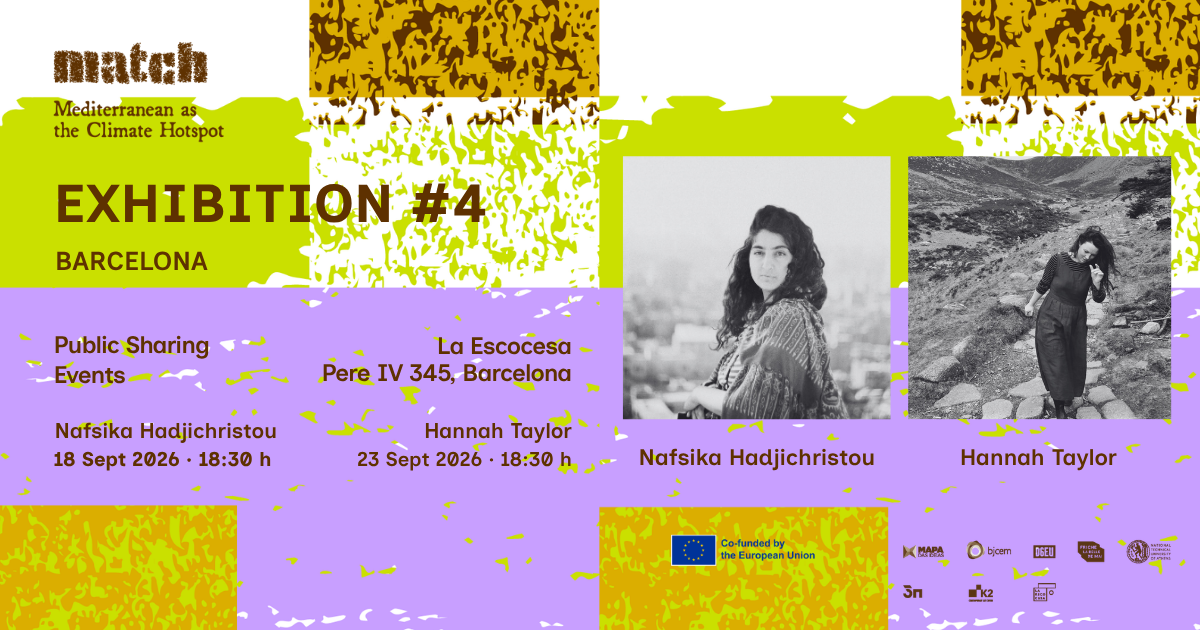
PUBLIC SHARING EVENTS: 18 & 23 SEPTEMBER 2026
The MATCH journey continues in Barcelona with the fourth exhibition, hosted by La Escocesa in September 2026.
During March 2026, as part of the MATCH (Mediterranean as a Climate Hotspot) programme, artists Hannah Taylor and Nafsika Hadjichristou undertook residencies at La Escocesa. Through field research, conversations, participatory workshops, and collaborations with local communities, they explored themes of climate change, urban ecology, collective imagination, and the relationships between people, plants, materials, and place. In September 2026, they return to La Escocesa to share the outcomes of their research through an open studio, an audiovisual presentation, and participatory activities inviting visitors to engage with their work and reflect on possible climate futures together.
Nafsika Hadjichristou‘s residency focused on collective imagination as a tool for rethinking our relationship with climate change, deep time, and the living world. Through conversations, participatory workshops, and collaborations with community gardens and social spaces, she explored how collective practices can open alternative ways of living and imagining futures beyond climate collapse.
Hannah Taylor‘s research centred on the relationships between people, plants, materials, and urban landscapes. Through walks, fieldwork, and collaborations with community gardens, syntropic agriculture projects, and informal networks of material reuse, she investigated practices of ecological care, repair, and resilience, working with overlooked vegetation, discarded materials, and the material flows that shape the city.
Public Sharing Events
La Escocesa, 18 September 2026, 18:30 h
Nafsika will screen an audiovisual piece developed from fragments of conversations, drawings, collages and collective speculation gathered throughout the residency. The presentation will be accompanied by an open conversation and a participatory moment, inviting visitors to reflect on how we imagine -and practise- collective futures.
La Escocesa, 23 September 2026, 18:30 h
Hannah Taylor opens her studio to present an evolving body of research through soil chromatography, naturally dyed textiles, metal oxide inks, aluminium casting, and welded sculpture. Throughout the evening, the studio will remain open as a space for experimentation, conversation, and collective exchange, where visitors are invited to engage with handmade botanical inks and metal oxides, witnessing the material interactions between plants, metals, and the environments they inhabit.
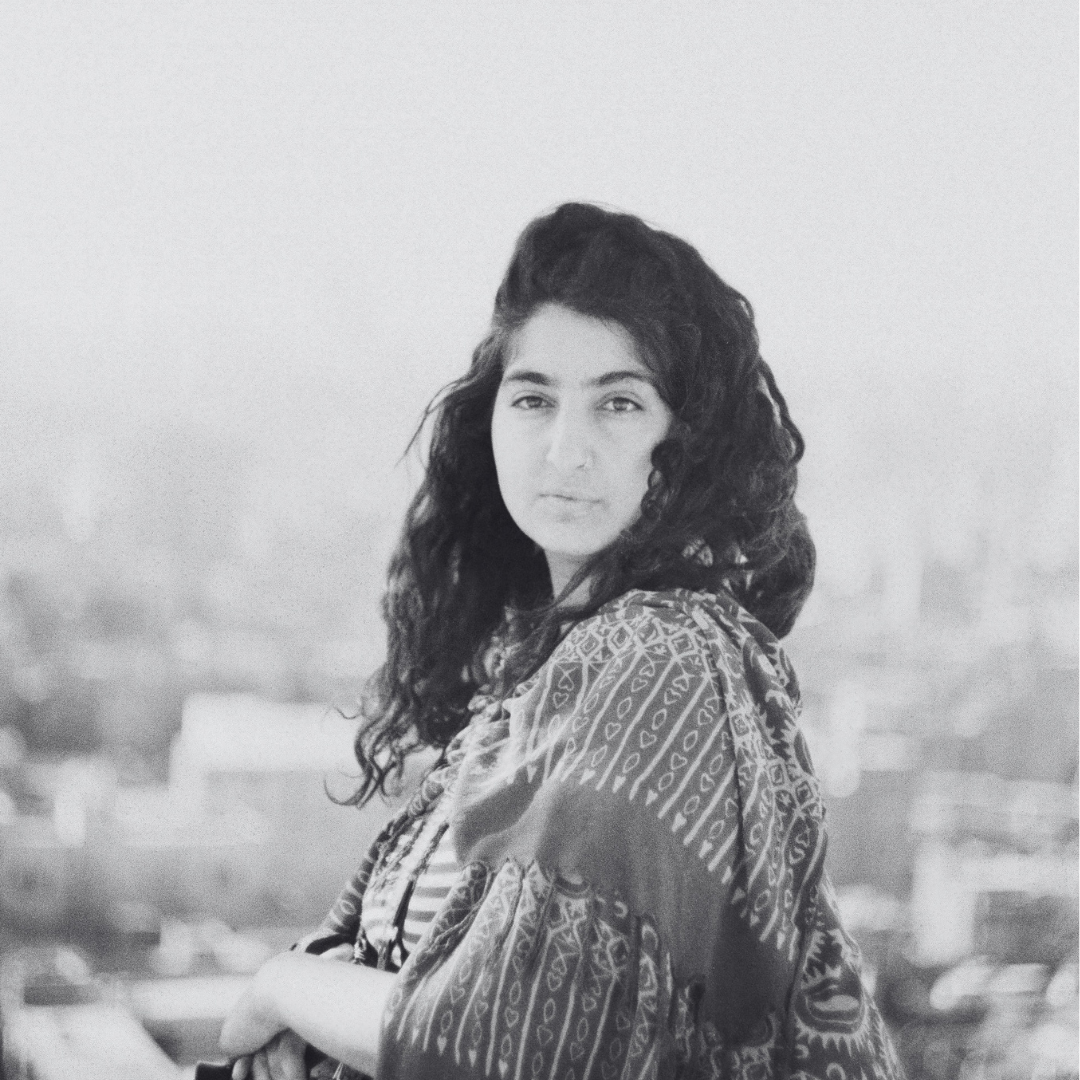
Nafsika Hadjichristou
Nafsika Hadjichristou is a visual artist from Nicosia, Cyprus, working with photography, film, and experimental storytelling. Rooted in slowness, memory, and poetic observation, her work weaves together images, writing, scrapbooking, animation, and sound into intimate, tactile reflections on land, resistance, and belonging. With a background in documentary and a deep commitment to collaborative and participatory practice, she has worked locally in her country, as well as in solidarity with communities in Latin America, exploring how storytelling can resist erasure and nurture social change. She sees artistic practice as a space for reflection, community, emphathy and connection— between personal diary, archive, and collective memory. She holds a BSc in Film and Television Production from the University of York.
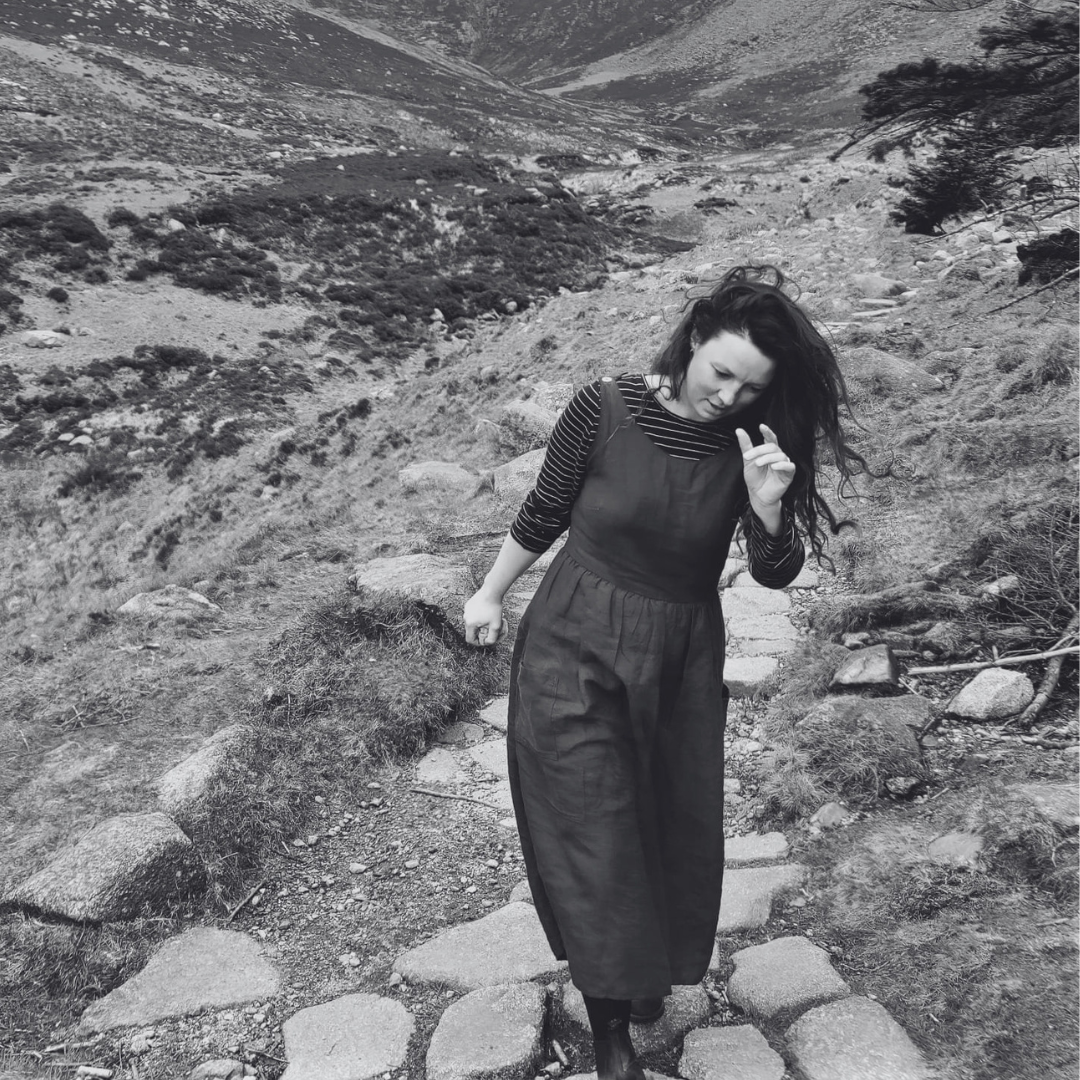
Hannah Rebekah Taylor
Hannah Rebekah Taylor (1993) is a grower, dyer and artist. She was born in the UK and spent her childhood growing up in South Africa and later rural England. She studied Anthropology at Sussex University. She has lived and worked in Paris, London, and Marseille where she now resides in the Belle de Mai neighbourhood. Her work draws from her cross cultural upbringing and her Anthropology studies, exploring story telling and human connection to land, environment and found materials, specifically in the context of the climate crisis. Hannah works predominantly with reclaimed and foraged materials, natural dyes and pigments. She has previously collaborated with ‘The School of Mutants’ collective. Her work has been shown in London, Kaunas, Ljubljana and Marseille.